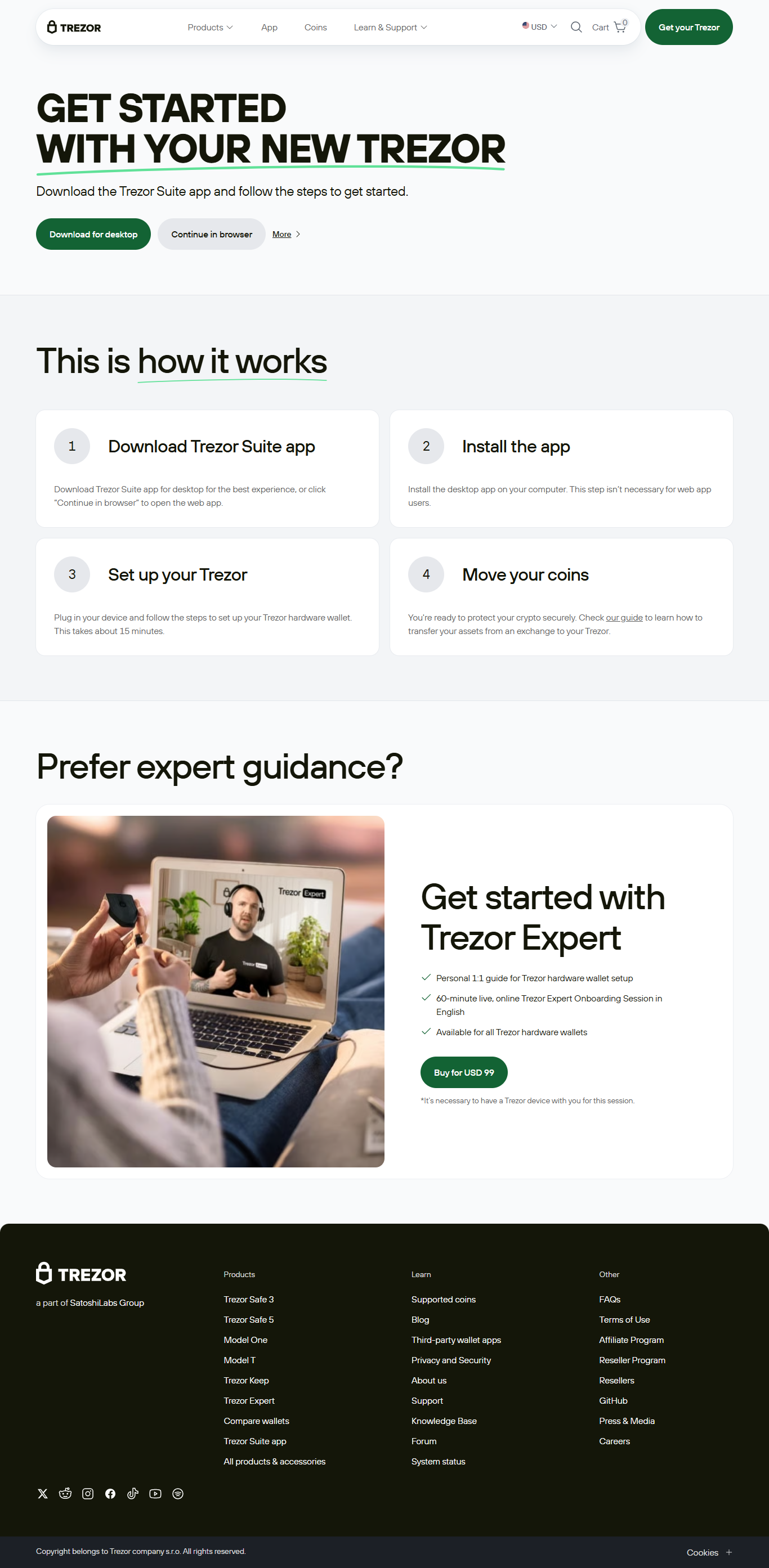
Learn how to securely set up your Trezor hardware wallet, protect your cryptocurrency investments, and start trading with confidence. This step-by-step guide follows best security practices for beginners.
Before we dive into the setup process, it's important to understand what makes Trezor different from typical cryptocurrency exchanges. Trezor is a hardware wallet - a physical device that securely stores your cryptocurrency private keys offline. This approach, known as "cold storage," provides significantly better security than keeping your crypto on an exchange.
Expert Tip: Unlike exchange accounts, Trezor doesn't require KYC verification because you're storing your own assets rather than entrusting them to a third party.
When your Trezor arrives, carefully inspect the packaging for any signs of tampering. The holographic seal should be intact. If anything looks suspicious, contact Trezor support immediately before proceeding.
Security Warning: Only purchase Trezor devices from the official Trezor.io website or authorized resellers. Third-party marketplaces may sell tampered devices.
Visit the official trezor.io/start page to download Trezor Suite, the desktop application that interfaces with your hardware wallet.
Connect your Trezor to your computer using the provided USB cable. Follow these steps in Trezor Suite:
This is the most critical security step in the entire process:
Critical Security Notice: Your recovery seed is the master key to all your cryptocurrency. Anyone with access to these words can steal your assets. Trezor will never ask for your seed phrase.
Create a PIN code to protect your device from physical access:
Once setup is complete, familiarize yourself with Trezor Suite:
For additional security, consider enabling the passphrase feature, which adds a 25th word to your recovery seed that isn't stored on the device itself.
Always keep your Trezor firmware updated to benefit from the latest security patches and features. Trezor Suite will notify you when updates are available.
Always double-check receiving addresses on your Trezor's screen before sending large amounts of cryptocurrency.
When making transactions, ensure you're using a malware-free computer and a secure internet connection.
Trezor is a hardware wallet that gives you full control over your cryptocurrency private keys. Exchanges like Coinbase or Binance hold your keys for you. With Trezor, you truly "own" your crypto, while with exchanges, you have an IOU.
Yes, your Trezor can be used with any computer that has Trezor Suite installed. Your cryptocurrency isn't stored on the device itself but on the blockchain. The Trezor simply stores your keys and signs transactions.
If you lose your Trezor but have your recovery seed, you can restore your entire wallet on a new Trezor device or compatible wallet. This is why protecting your recovery seed is so important.
Trezor Model T can connect to Android devices with OTG cable support. Trezor Suite is also available as a web app that works with mobile browsers, though the desktop application offers the full feature set.
Both Trezor and Ledger are reputable hardware wallet manufacturers. Trezor uses open-source software, which allows for community auditing, while Ledger uses a closed-source secure element. Both offer excellent security when used properly.
Yes, because Trezor uses standard BIP39/BIP44 protocols, your recovery seed can be used with many other wallet software and hardware products, ensuring you're never locked into a single company's ecosystem.
For the most accurate and up-to-date information, always refer to official Trezor resources: